Anthropic's Dark Factory
Anthropic’s release cadence is showing companies what an AI-native operating model looks like in practice, and why the real challenge is organizational adoption, not model access.
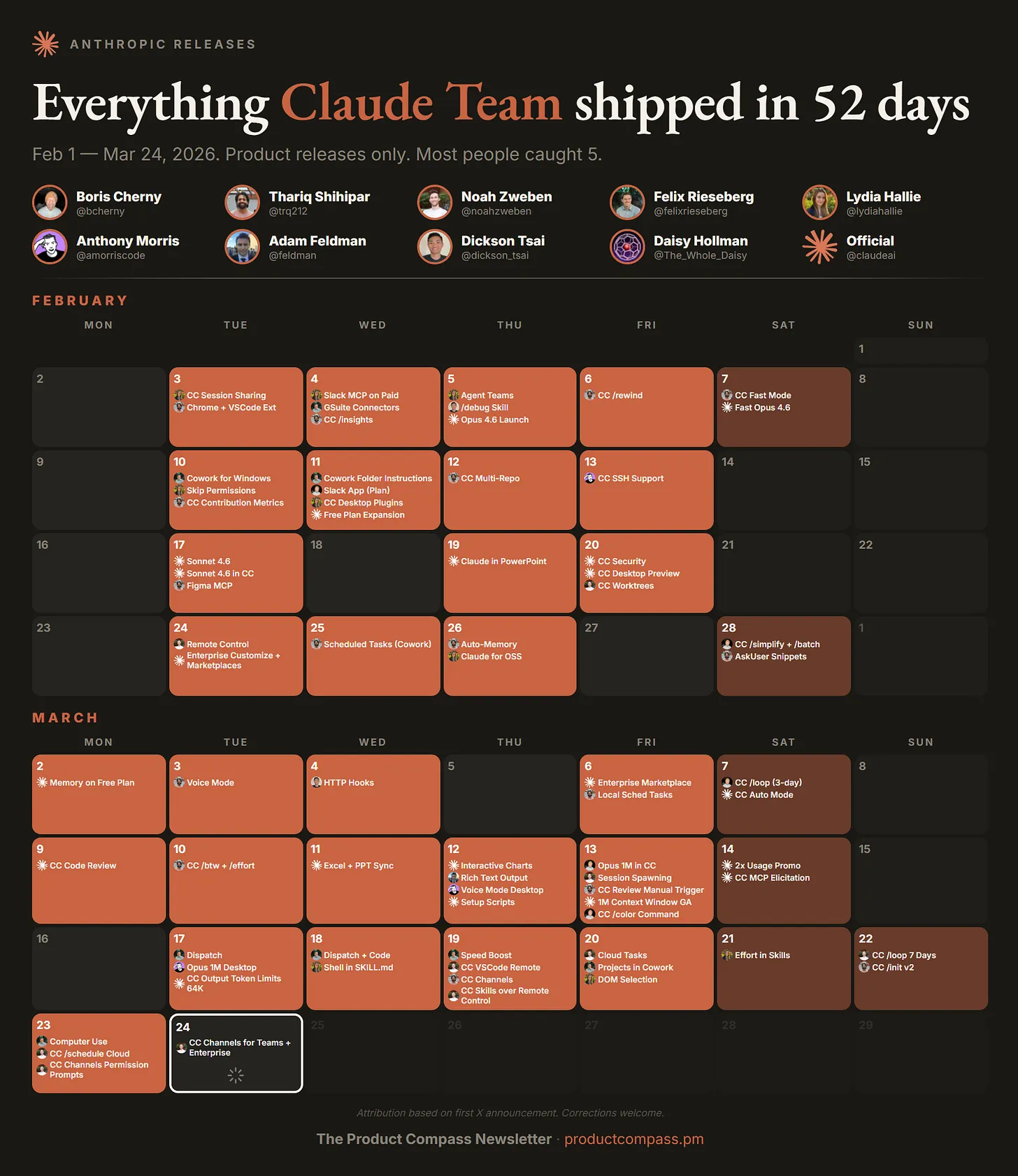
Anthropic shipped 74 features in 52 days.
Most companies see that and ask: which model are they using, and how do we get access?
A more useful question is what has to change inside your company to produce output at that cadence.
Because plenty of companies already have access to the same models. But is anyone else producing anything close to that level of throughput?
The gap isn't model capability. It's how the work is structured, and that's model-agnostic.
What Anthropic seems to be doing, and to their credit they're showing a lot of it publicly, is breaking work into smaller pieces, routing it to the right place, putting clear review points in, and only escalating when something actually needs human judgment. Humans are still in the loop, but not sitting inside every step.
If you've ever run any part of a global support model, this should feel familiar. Intake, triage, routing, escalation paths, SLAs. The difference is the first line isn't a person anymore.
That's why the dark factory analogy fits.
In manufacturing, a dark factory isn't about removing people. It's about removing people from the wrong parts of the process. The system handles the flow. Humans design the system, monitor it, and step in when something breaks.
That's what this looks like applied to software, but honestly it's not just software development that could benefit from this kind of shift.
Anywhere work gets classified, handed off, stitched together, reviewed, and occasionally escalated, you can redesign it this way. Service desks. Project management. HR ops. Finance workflows. A lot of internal operations are just queues with rules layered on top.
And in many of them, people are effectively acting as glue to keep the process from stalling.
The shift is that the system handles that flow directly. Humans stop being the glue and move up to designing, monitoring, and fixing it when it breaks.
This doesn't need to be perfect to be better. Most human workflows already aren't. Service desks misroute tickets. Escalations bounce. Project updates show up late or missing half the context stakeholders actually want. That's your baseline.
And now that you have that baseline compare the automated version against it. If the system can classify, route, or draft work at roughly the same level, and a human layer sits above it to catch the misses, you already have something useful. Improve from there.
A lot of early AI efforts fail because they expect automation to be flawless while giving the old human process a free pass. Usually the issue isn't the model. It's that nobody gives the new process time to learn, adapt, and improve. Give the team room to do that, and the new system should end up better than the one it replaced.
That's also why the big AI vendors keep partnering with consulting firms. It's not that the models are hard to use. It's that translating them into a working system inside a real company is messy.
Anthropic are making parts of that visible through diagrams and workflows. Yes, it's marketing. But it's useful marketing. It gives you enough to start sketching what this could look like internally before you go spend a few million dollars on someone else to tell you.
Don’t read this and come away thinking, ‘we should buy Claude.’
There are multiple models that are already good enough for a lot of this, and the leader will probably keep changing.
The takeaway I want to impart is that companies that figure out how to structure work this way will move faster than the ones that just layer AI on top of existing processes.
That's what their release cadence is really signaling.
Not just a strong product team, but a company that's learning how to run itself differently.
And that's where most companies are starting to fall behind.