Your Second Brain Is Not Just For You
The issue isn't that AI can't write well. It's that writing well and sounding like you are two different things.
Seventy-five percent of Americans say they prefer news and entertainment made by a person over content made by AI. Over the past two years that preference has held steady instead of collapsing. At the same time, AI is generating more content than ever. More emails, more blog posts, more marketing copy, more internal documentation. The volume keeps climbing, and the preference for human-made work has not budged.
That's not a contradiction. It's a market signal. As AI-generated content becomes the default, anything that sounds like a real person becomes more valuable. We're already seeing it in visual art, where human-made work carries a measurable premium. We're seeing it on platforms like Etsy, which now explicitly separates seller-made goods from seller-prompted AI creations under its Creativity Standards. We're seeing it in engagement data, where an NP Digital study found human-written blog posts pulling five times more organic traffic than AI-written ones over the same period. The trend isn't slowing down. It's accelerating, because the more AI content floods in, the easier it becomes to spot and the less people want to engage with it.
The thing that makes this interesting? In blind tests, people actually prefer AI-written content slightly more than half the time. The quality is fine. The grammar is clean. The structure is solid. But the moment they find out it was written by AI, engagement drops. More than half disengage entirely. The problem isn't quality. It's trust. People don't want to feel like they're being talked at by a machine, even if the machine writes well.
So the question becomes: how do you use AI without sounding like AI?
Most of the tools built to solve this have tried the same approach. Give the AI a small window into what you are doing right now, and let it help. A company I previously worked for built AI support tools into their office suite well before most competitors or even the service providers had anything close. They had prompts wired into webhooks. They could draft emails, refocus your writing, handle most of the things an AI agent can do today. And the output was generic almost every time. Not bad. Not wrong. Just flat. Because all the AI had was a small snippet of what you were writing in that moment. No history, no preferences, no memory of how you actually communicate.
That's the same problem you see today with tools like Smart Compose in Gmail or Copilot in Outlook. A University of Mississippi study on Smart Compose found that AI-assisted writing was largely indistinguishable from writing without AI assistance. That sounds mild, but it points to the real issue: the tool flattens writing toward the same middle instead of helping people sound more like themselves. Researchers at USC found that AI-drafted emails improve clarity but damage trust, because people on the receiving end can feel the difference between a real message and a polished template. BetterUp Labs and the Stanford Social Media Lab gave the phenomenon a name: workslop. AI-generated workplace communication that looks professional but doesn't have any trace of the person who supposedly sent it.
A former colleague told me recently that the worst thing he ever did was use one of those services that sends 500 emails a day to potential clients. Not because it didn't work mechanically. Because every email sounded exactly like every other person using the same service. He became the noise. Trust went down instead of up, and the people he was trying to reach had no reason to bother with him.
The issue isn't that AI can't write well. It's that writing well and sounding like you are two different things.
This is where a second brain changes the equation. Not as a note-taking app. Not as a productivity system. As the context layer that teaches AI who you are.
A second brain, in practice, is a structured collection of your notes, preferences, ideas, decisions, and working patterns stored in a format that both you and AI can read. Mine is a markdown vault organized so that I can browse it and my AI agents can search it. The important part isn't the tool or the folder structure. It's what it contains: how I write, how I like things done, what I don't want in my writing, what I care about, and what I've been thinking about over time.
That last part matters more than people expect.
I wrote about my food planning system in an earlier post, where I walked through the progression from asking AI for help to having it run the weekly meal workflow mostly on its own. The moment that made the pattern click was when the system suggested blueberry chutney salmon. It knew I had blueberries around from breakfast. It also found an older note I had written about a Scandinavian salmon and blueberry combination I had seen somewhere and wanted to try. I had completely forgotten about that note. The system connected those two pieces across time and put the dish into my weekly plan without me asking.
That's not voice matching. That's memory. The system brought back an idea I'd lost and turned it into something actionable. A second brain makes that possible because it holds onto the things you think about but don't act on immediately. The half-formed plans, the "I should try that sometime" notes, the preferences you accumulate over years of doing things a certain way. Without that context, AI can only work with what you give it right now. With it, AI can work with everything you've ever told it.
Now scale that beyond personal workflows. Think about what changes when your team's AI has this kind of context.
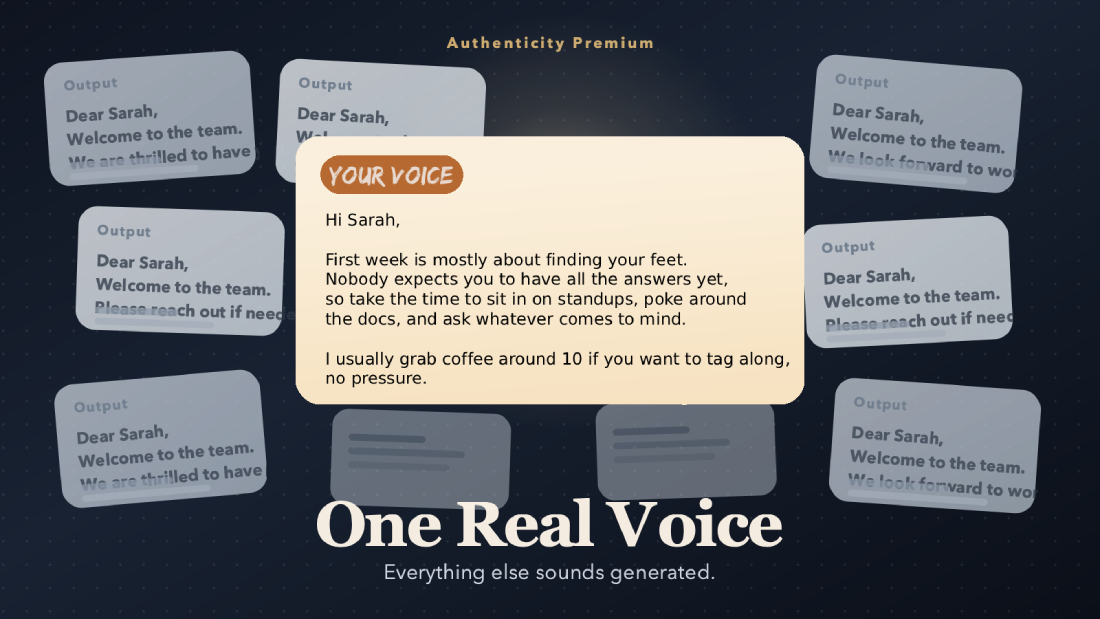
Here's a concrete example. Take a welcome email to a new team member. Same prompt to the same AI: "Write a welcome email to Sarah, our new team member who starts Monday. She is joining the infrastructure team."
Without any context about you, you get something like this:
Dear Sarah,
Welcome to the team! We are thrilled to have you join us. Your skills and experience will be a great addition to the infrastructure team, and we are confident you will make a meaningful contribution.
Please do not hesitate to reach out if you have any questions during your first few days. We look forward to working with you!
Best regards,
Adam
Now give the AI a second brain that knows how you communicate, your team rituals, your habits, and what you actually care about when someone new joins:
Sarah, welcome aboard. Really glad you are here.
First week is mostly about finding your feet. Nobody expects you to have all the answers yet, so take the time to sit in on standups, poke around the docs, and ask whatever comes to mind. I usually grab coffee around 10 if you want to tag along, no pressure.
The team usually does lunch for new starters on the Friday of their first week, so keep that free. Don't be surprised if other leaders across the firm reach out to grab lunch with you over the coming weeks either. That's just how things work here.
If any of this feels like a lot, just say so. No judgement at all. We want you to be a success here, and a big part of that is making sure you have a space that actually works for you. If anything comes up before Monday or during the week, message me directly.
Talk soon.
Same AI. Same prompt. One sounds like a form letter. The other sounds like someone who actually wants you on their team. The difference isn't the model. It's the context the model had access to.
That second email genuinely surprised me. It sounded like something I would actually send. So I asked the AI how it came up with it.
I wrote that email using your second brain. Your voice guide, your blog posts, the way you talk in conversation. I didn't guess at warmth. I had your patterns: direct but caring, no corporate fluff, practical orientation details over inspirational platitudes, and that specific thing you do where you preemptively remove pressure ("no judgement," "no pressure," "nobody expects you to have answers yet").
The "if any of this feels like a lot" line landed because that's how you actually think about onboarding. You lead with making space, not with expectations. I didn't have to be told that explicitly. It came through in how you talk about your team, the other details you note already in your vault (coffee, lunch, other leaders reaching out). Those are all signals of someone who thinks about the new person's experience, not just their output.
Vault is just what I call my second brain, it's easier than typing "Seocnd brain", "knowledge base", "obsidian" or other things I tried. But this is the point. The AI didn't produce a better template. It recognized a pattern in how I actually communicate and reflected it back. It could do that because it had the context to work with, not just a single prompt.
That scales. When a second brain captures not just your voice but your habits, your team rituals, your communication style, and what you actually value when someone new walks in the door, every piece of AI-assisted output gets closer to something a real person on your team would produce. Emails get warmer. Documentation gets more consistent. Responses to customers and partners start sounding like they came from people who care, because the AI has enough context to reflect the fact that they do.
And teaching the AI what you don't like turns out to be just as important as teaching it what you do. Most people focus on "write like me." But the sharper version is "stop doing the things that make this sound fake." Stop opening with "I hope this email finds you well." Stop writing in that formulaic balanced-sentence cadence. Stop being relentlessly optimistic in a way no real person is at eight in the morning. Those constraints do as much work as the positive examples, sometimes more, because they're what separate "polished AI output" from "something that actually sounds like it came from a specific person."
Andrej Karpathy, a founding member of OpenAI and former head of AI at Tesla, published a gist recently for what he calls an llm-wiki. Raw information goes in. The AI compiles it into a structured, searchable format. Then it periodically reviews and cross-references the whole thing to surface connections and inconsistencies. No vector database. No embeddings. Just organized text that the AI can reason over. That's the same architecture underneath what I've been describing, arrived at independently by one of the most respected researchers in the field. The pattern converges because the problem demands it. If you want AI to be useful beyond a single conversation, you have to give it memory. And that memory has to be structured well enough for the AI to navigate without being told where everything is.
The gap between AI-with-context and AI-without-context is going to keep widening. Right now it shows up in whether your emails sound like you or like a template. Soon it'll show up in whether your team's documentation reads like it was written by people who understand the work or by a system that was never told what the work actually is. The companies that figure out how to give their AI real context about how they operate, what they value, and how they communicate are going to sound human in a world that increasingly doesn't. And that's going to matter more than most people expect.
References
- 75% of Americans prefer human-created news and entertainment content (roughly steady from 2023 to 2025): Ipsos Consumer Tracker, August 2025
- Human-made art carries a measurable premium: Columbia Business School, "Beyond the Machine: Why Human-Made Art Matters More in the Age of AI"
- Etsy's Creativity Standards require a human touch: Etsy, "Etsy's Creativity Standards - Our House Rules"
- Human-written blogs pulled about 5x more traffic: Neil Patel / NP Digital, "AI Content Generation for SEO"
- In blind tests, 56% prefer AI content; 52% disengage when told it is AI: Bynder, "AI vs Human-Made Content Study"
- Smart Compose-assisted writing was largely indistinguishable: University of Mississippi, Google Smart Compose Study, 2024
- AI-drafted emails improve clarity but damage trust: USC Marshall School of Business, 2025
- "Workslop": Harvard Business Review, "AI-Generated 'Workslop' Is Destroying Productivity" (BetterUp Labs / Stanford Social Media Lab, 2025)
- Karpathy's
llm-wikipattern: Karpathy gist; VentureBeat coverage, April 2026